
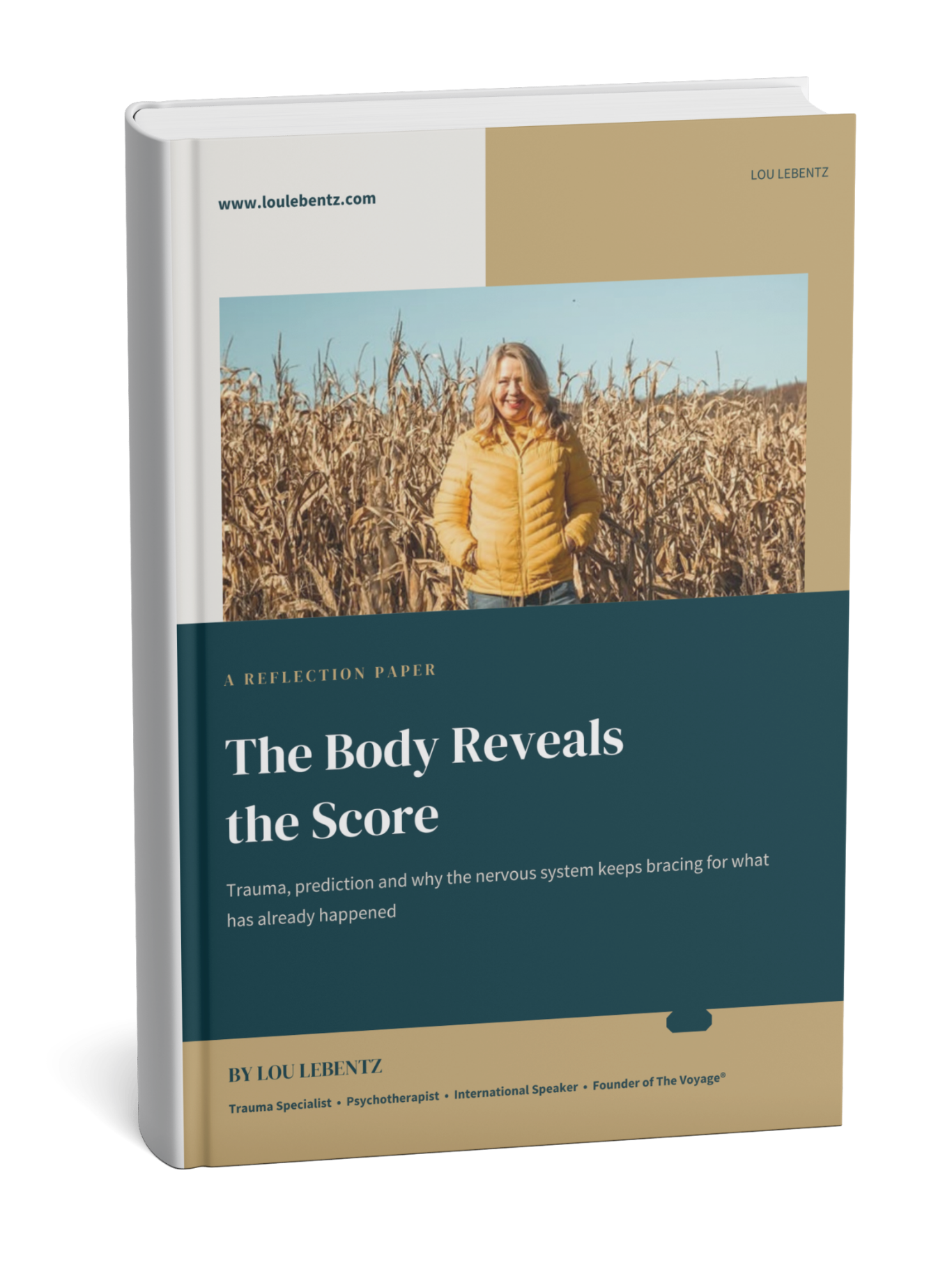
There is a cascade that happens within the system.
The brain predicts.
The body prepares.
The nervous system protects.
The beliefs explain.
The parts organise.
And thankfully the soul remembers – possibility.
For many years, the brilliant phrase “The Body Keeps the Score” has given language to something millions of people instinctively knew but could not always explain.
That language mattered. It moved trauma beyond purely cognitive explanations, validated the lived experience of people whose bodies continued to react long after the danger had passed, and helped explain why insight alone does not always heal.
But as trauma language entered mainstream culture, some of its most powerful metaphors became simplified.
And were understood as though the body were a storage unit, with traumatic memory sitting in the tissues waiting to be located, released or removed. This paper does not dismiss the body, embodied trauma work, or the cultural and clinical importance of Bessel van der Kolk’s contribution, which is massive.
It stands on the other side of the door that phrase opened — and asks whether the field is ready for a more multidimensional trauma lens. Not one that replaces one reduction with another. One that can hold the whole human being.
A traumatised system is not only responding to what happened then. It may be preparing for what it believes could happen next.
A belief is not simply a thought in the mind. It is a whole-system expectation shaped by childhood, attachment, nervous system state, memory and meaning.
People cannot always simply “choose better” when the nervous system is still predicting danger. What looks like self-sabotage may once have been an intelligent attempt to survive.
True resilience is the growing capacity to return, repair, regulate, reconnect and respond with more flexibility.
The nervous system does not update through insight alone. It needs repeated experiences of safety, agency, boundary, repair, regulation, compassion and relationship.
Trauma healing is not simply symptom reduction. It is the restoration of a human being’s capacity to feel safe enough to become who they came here to be.
The other six are waiting inside the paper.
Lou Lebentz

In Brief: Executive Summary & Twelve Key Ideas.
Part One
The Body Reveals the Score.

Part Two
The Phrase That Changed the Culture.

Part Three
A Note on Dignity Before We Go Any Further.

Part Four
When Metaphor Becomes Mechanism.
Part Five
The Predictive Brain.

Part Six
Beliefs Are Embodied Predictions.

Part Seven
Why Willpower Does Not Reach the Wound.

Part Eight
Resilience Is Not Pushing Through.

Part Nine
The Soul Beyond Survival.

Part Ten
What the Body Has Been Trying to Tell Us.

Conclusion
The Restoration of Possibility.
Written for clinicians, coaches, leaders, professionals and anyone drawn to a deeper, kinder understanding of why we brace for what has already happened — and how the whole system learns that something different can happen now.
Honouring the doorway that “The Body Keeps the Score” opened, and walking further through it: precise enough for the science, tender enough for the survivor, deep enough for the soul.
A reflection paper drawing on predictive processing research, attachment theory, parts-based approaches, polyvagal perspectives and more than two decades of clinical experience. Full references and source notes included.
Read the reflection paper
No need to enter your details just click here and the The Body Reveals the Score will download immediately.
Delivered as a beautifully designed PDF.

Trauma-Informed Systems Designer · International Speaker · Creator of The Voyage®
Lou Lebentz is the creator of The Voyage® and founder of The Voyage® Academy, a trauma-informed training and systems change organisation working across the UK and US. With a background spanning more than two decades of clinical practice in the mental health and addiction field, Lou now works with clinicians, coaches, leaders, organisations and treatment providers to deepen understanding of trauma, nervous system regulation and the conditions required for meaningful healing.
Her work brings together clinical expertise, lived experience, compassion and a wider social vision: that trauma is not only a personal issue, but a human, relational and cultural one.
Through The Voyage®, The 4P Protocol™, Trauma Aware Practice Training and her emerging reflection paper series, Lou is committed to helping create a more regulated, humane and trauma-informed world.
At the heart of this paper is a simple but profound conviction: trauma narrows prediction. Healing widens possibility.
We use cookies to improve your experience on our site. By using our site, you consent to cookies.
Manage your cookie preferences below:
Essential cookies enable basic functions and are necessary for the proper function of the website.
These cookies are needed for adding comments on this website.
Statistics cookies collect information anonymously. This information helps us understand how visitors use our website.
Google Analytics is a powerful tool that tracks and analyzes website traffic for informed marketing decisions.
Service URL: policies.google.com (opens in a new window)