
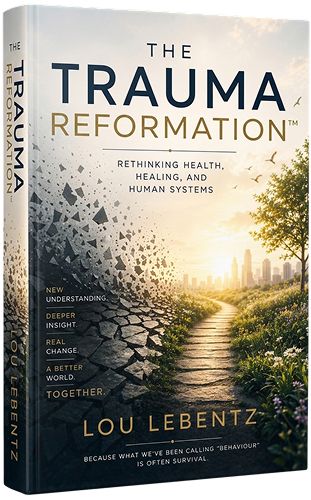
The Trauma Reformation™
Rethinking Health, Healing, and Human Systems
- The Idea
- The Book
- In Practice
- Follow the Work
What if everything I’d been told was wrong with me was actually just my nervous system doing exactly what it was designed to do?
Trauma is not the problem.
The way we respond to trauma is.
Across healthcare, education, justice, leadership, and social systems, trauma is routinely misunderstood as pathology, dysfunction, or personal failure. Well-intentioned systems focus on symptom management, speed, and individual responsibility — while quietly recreating the very conditions that overwhelm human nervous systems in the first place.
The Trauma Reformation™ is Lou Lebentz’s name for the shift she believes is both necessary and already underway: a fundamental change in how we understand suffering, who carries responsibility for it, and how our systems are designed in response.
The Idea
We are living through a moment of profound potential.
Neuroscience has given us the tools to understand human behaviour differently. Trauma research has given us the evidence base. What is needed now is the translation — into policy, into institutional design, into how we train the professionals who hold our most vulnerable systems together, and into how we understand leadership, culture, and care.

01
Trauma is adaptation, not pathology
What we call symptoms are survival strategies. They made sense at the time. The most damaging aspect of trauma is rarely the original experience — it is what happens after, in how people are responded to, managed, rushed, or blamed.
02
Systems have nervous systems too
Organisations and institutions under pressure become defensive. They prioritise reputation over repair, compliance over care, speed over safety. These are not moral failures. They are trauma responses at scale. A dysregulated system cannot regulate the people inside it.
03
Healing cannot succeed in isolation
When people are asked to self-regulate inside structurally dysregulating environments — unsafe workplaces, rushed services, unequal power structures, productivity cultures — healing becomes a private burden rather than a collective responsibility.
04
Regulation is the missing foundation
Across therapy, leadership, education, and governance, regulation — not insight, not compliance, not willpower — is the precondition for change. Regulation before Revelation. Safety before Story. This is not a therapeutic nicety. It is a structural requirement.
The Trauma Reformation™ is not about making everyone a therapist.
It is about ensuring that the people who shape our systems — our leaders, our institutions, our policymakers — understand enough about how human beings actually work under pressure that they stop designing environments that make things worse.
Not blame. Not revolution. Maturity. And a different kind of design.
Four Principles of The Trauma Reformation™
These are not interventions. They are the organising logic of a different way of designing systems, services, and cultures.
Regulation before response
No ethical decision-making, no genuine accountability, no lasting change happens without nervous system safety. Regulation is not a precursor to the real work. It is the real work.
Shared responsibility
Trauma cannot remain an individual burden inside collective systems. When the conditions that create suffering are structural, the response must be structural too.
Early intervention over crisis fixation
Most systems invest heavily in crisis and containment while neglecting prevention and early regulation. Prevention is more humane, more effective, and more sustainable across generations.
Early intervention over crisis fixation
Most systems invest heavily in crisis and containment while neglecting prevention and early regulation. Prevention is more humane, more effective, and more sustainable across generations.

The Trauma Reformation™
Rethinking Health, Healing, and Human Systems
Lou’s first book — currently in development.
This is not a therapy book, a self-help manual, or a programme guide. It is a thought-leadership work that speaks across sectors — offering a new lens through which to understand human behaviour, organisational failure, burnout, conflict, and social breakdown.
Written for professionals, leaders, policymakers, and thoughtful general readers, it challenges the question ‘What’s wrong with you?’ and replaces it with ‘What happened — and what shaped the response, individually and systemically?’
At its heart, The Trauma Reformation™ is an invitation to rehumanise how we care, how we lead, and how we live.

The Trauma Reformation™ in Practice
This is not a concept that lives only in books and keynotes. It is already taking shape — through The Voyage® Academy’s work across sectors and settings.
In criminal justice
The Voyage® for Prisons brings a trauma-informed framework to governors, officers, and those in custody — built on the understanding that most of what ends up in the justice system has trauma at its root.
In sport
The Voyage® for Sport is bringing the framework into coaching, athlete development, and sporting culture — addressing the hidden cost of high-performance environments on the human nervous system.
In leadership
Return on Regulation™ gives organisational leaders a practical framework for understanding why nervous system regulation is not a wellbeing nice-to-have — it is a performance and culture imperative.
In frontline services
The 4P Protocol™ — Protection, Prevention, Presence, Possibility — gives frontline professionals the framework to sustain themselves and the people they serve without burning out in the process.
In clinical training
The Voyage® Essentials, TAPT, and Deep Dive programmes are training a generation of practitioners who understand trauma as protection, not pathology.
The Book in Brief —
Twelve Chapters, Four Parts
PART ONE — Seeing the Problem Clearly
Chapter 1
When Helping Hurts
How well-intentioned systems end up recreating harm — not through bad intent, but through outdated frameworks that mislabel trauma responses as resistance, pathology, or bad behaviour.
Chapter 2
Trauma Is Not the Problem
Trauma reframed as adaptation rather than dysfunction. The most damaging aspect of trauma is often what happens after — in how people are responded to. This chapter removes shame and restores meaning.
Chapter 3
How Healing Became a Private Burden
How well-intentioned systems end up recreating harm — not through bad intent, but through outdated frameworks that mislabel trauma responses as resistance, pathology, or bad behaviour.
Chapter 4
The Cost of Ignoring the Nervous System
The nervous system as the missing foundation across therapy, leadership, education, and justice. Why insight alone doesn’t heal. Why urgency overrides safety. Why overwhelmed systems cannot make ethical decisions.
PART TWO — Understanding Trauma in Systems
Chapter 5
Trauma Lives in Human Systems
Trauma moved out of the therapy room and into the wider world — how it embeds itself in families, organisations, cultures, and nations, and how systems develop their own survival strategies.
Chapter 6
When Systems Protect Themselves Instead of People
How institutions prioritise reputation, compliance, and risk management over repair — and why defensiveness, shame, and fear as systemic trauma responses block learning and accountability.
Chapter 7
Lived Experience as Intelligence
Lived experience reframed as a form of knowledge, not anecdote — and why reform requires listening differently, including challenging who is seen as an ‘expert’ and why.
Chapter 8
Regulation Before Revelation
A cornerstone chapter. Regulation as the precondition for insight, accountability, justice, and change — and what this principle looks like in practice across therapy, leadership, education, and governance.
PART THREE — What Reform Actually Requires
Chapter 9
Response to Early Intervention
Why systems invest in crisis and containment while neglecting prevention — and what trauma-aware early intervention actually looks like across generations.
Chapter 10
Rehumanising Leadership and Responsibility
Leadership through a nervous system lens — how regulation changes decision-making, culture, and outcomes, and why responsibility is relational and ethical rather than controlling.
Chapter 11
Healing as Cultural Evolution
Healing reframed as a cultural and ethical evolution — what it means to build systems where safety and humanity are not traded for performance.
Chapter 12
The Trauma Reformation
The closing chapter brings the argument together. Collective responsibility without placing the burden on individuals. Grounded, oriented, and aware of how each of us participates.
Follow the Work
The Trauma Reformation™ is an emerging body of thought leadership — growing through writing, speaking, policy engagement, and the ongoing work of The Voyage® Academy.
If you’d like to follow its development — including updates on the book, new writing, and speaking dates — join the newsletter.